
By: Taylor Stimpson
Program Manager, Academy for Sustainable Innovation
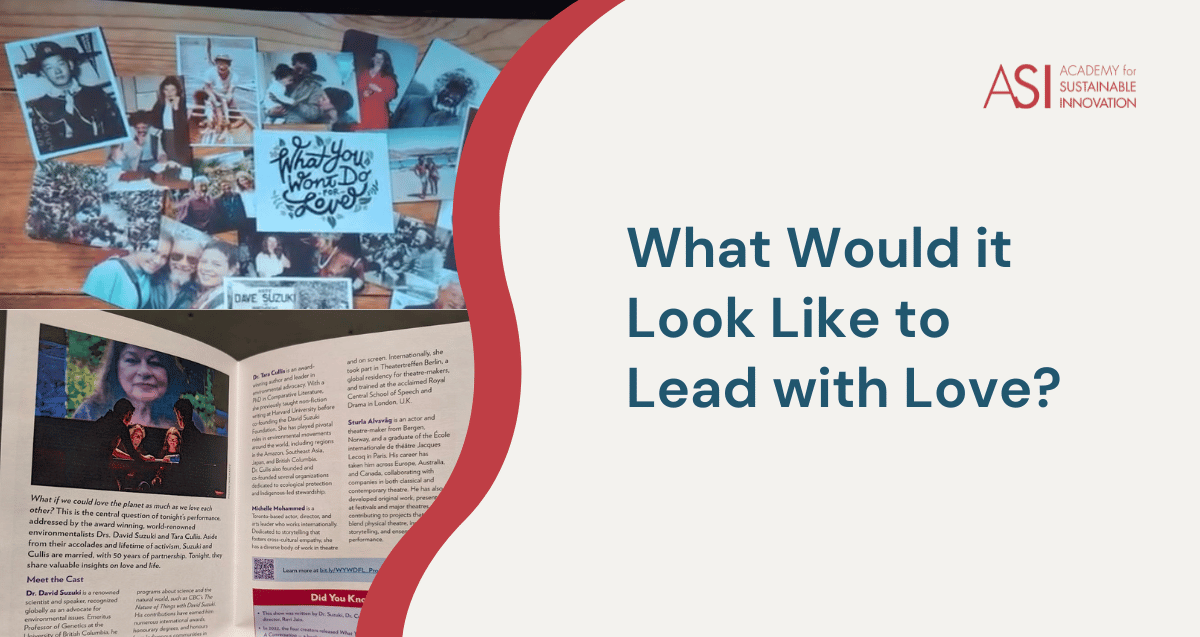
It’s early Spring here in Ontario. I’m walking around the neighbourhood, noticing the rush of the creek after a big thaw, the twinkling sound of the returning birdsong, and both people and critters yawning their way out of hibernation, stretching into the most welcomed sunlight. As I saunter, taking in the soil-scented air, I’m reflecting on my recent attendance at a play featuring renowned Canadian environmentalists, climate activists, and married partners, David Suzuki and Tara Cullis, sweetly named, “What You Won’t Do for Love.” I’m thinking of our roles leading climate action – the very serious work of it – and sitting with the question: “What would it look like if we all did this work from a place of reverent love?”
Put on by the Why Not Theatre, the play toured Ontario throughout February and March of 2026, bringing together thousands of community members across cities and small towns in the province. The project began when Miriam Fernandes, a Toronto-based artist, actor, and Co-Artistic Director of Why Not Theatre, sent a hopeful email to David and Tara. As a young person, Miriam grew up watching David Suzuki’s programming on TV, a household name for many Canadians. She wanted to bring their story to the world in a different way, sharing just that – their story. But not just about the “science of things,” or the work that the David Suzuki Foundation has done. At the core of it, Miriam wanted David and Tara to share a story about love. Miriam wanted to know, and to share with others, how their lifetime of devoted activism was also a devotion to love: to each other, to their families, to their communities, and to the earth.
Before a script was written, Miriam, along with her fiancé/actor Sturla Alvsvåg, started with conversations. Around kitchen tables, on living room couches, on walks along the Pacific Ocean from David and Tara’s home in BC. They asked questions, shared stories, and captured memories that they felt were important to share with others. The very beginnings of this project are a testament to how important it is to take time to understand each other’s stories and start from a foundation of connection. Written into a script, bits of these conversations were performed live on stage by Michelle Mohammed as Miriam, alongside Sturla, David, and Tara as themselves. Worried about performing a memorized script, David and Tara agreed to the performance on the condition that they could read off the script on stage; not conventional, but neither was the premise of the play. Harkening back to the aptly named production studio, the team said, “Why Not?”
What resulted was 90 minutes of humbling, honest performances about addressing the climate crisis and its causes from a place of deep love and connection: to the planet and to each other. Further, for all of the professionalism and posturing that the sustainability and climate space can often be fraught with, it was wildly refreshing to experience the candour of this performance, juxtaposed with some of the disconnected conversations that can often be had around the subject of our climate crisis. Scripted lines were skipped, laughs were had, and we weren’t made to pretend that the people on stage weren’t also fallible. David and Tara didn’t feel put up on a pedestal or in the shining spotlight; they felt like old friends, peers, and people working alongside us to make change. We were invited into the intimate memories of their lives, their love, and the commitment to the earth and her inhabitants that serves as the foundation of their 50-year partnership together. This moving performance was a reminder that leadership can look like opening up our hearts, making mistakes, and adapting as needed.
They reminded us that, celebrity-status or not, no one person can do this work solo; we need each other for the medicine of shared laughter, for the sustenance of shared meals, for the momentum of shared purpose and action.
The stories that David and Tara shared spanned their early life as young activists, their work stopping pipelines and clearcutting projects across the world, David’s time on TV (including his CBC program, The Nature of Things) and Tara’s role in encouraging David to start a foundation to broaden the impact. In each story, they were never alone. Besides having each other at every turn, they were always surrounded by friends, family, allies, and community members who were fighting, working, and loving alongside them. They reminded us that, celebrity-status or not, no one person can do this work solo; we need each other for the medicine of shared laughter, for the sustenance of shared meals, for the momentum of shared purpose and action. Good leaders don’t lead solo; they know that we need people in all places, taking on a multitude of roles, leading together to make things happen.
As David and Tara reflected on their activism and change efforts from their younger years, they celebrated what they accomplished; they had fought hard, rallied people together, and pushed back against destructive projects, policies, and actions. But what they were devastated to share was that, for no lack of trying, these same or similar projects were cropping up again, with the same threats to our environment, people, and culture that were present decades ago. They implored us, Miriam (acted through Michelle), Sturla, and us, the audience, to take this as a lesson to lead systems change. A band-aid solution can always be ripped off, but systems change: that’s where the transformation happens. Can we lead towards a better, different future? Not just patching up the present?
What struck me most, though, was a question that came up after the performance. David remarked that he’s always asked what keeps him and Tara hopeful and keeps them from getting depressed at the state of things. He answered, bluntly: “We are depressed!” Going on to say, they’ll drop the guise that this work isn’t ever heartbreaking, exhausting, or grief-stricken. To fight for what you love, against the powerful systems at play, is no easy feat. But when we remember the root of it – the love of it – it makes the tribulation unquestionably worth it. Because, as the title suggests to us, “What wouldn’t we do for love?”
This moving performance invited us to remember that leadership can happen around kitchen tables, with good stories and hearty laughs, with our hearts on our sleeves. As David and Tara pass the torch to our next generations, we’re encouraged to learn from our elders, both in what they’ve accomplished and what we can still do. Let’s channel our fear, anger, grief into love – and let that lead us into a better future, together.

For the Love of Earth
This Earth Day, we’re inviting you to practice a little gratitude for the place we call home.
The ASI team will be sharing personal photos and reflections that begin with the phrase:
For the love of [what we cherish about Earth]
We’re building a community collection of photos, videos, and words through a Thankbox message board – come add your voice and let us know what you love about this beautiful planet.
Everyone who adds to the board will be entered to win a $25 MEC gift card.