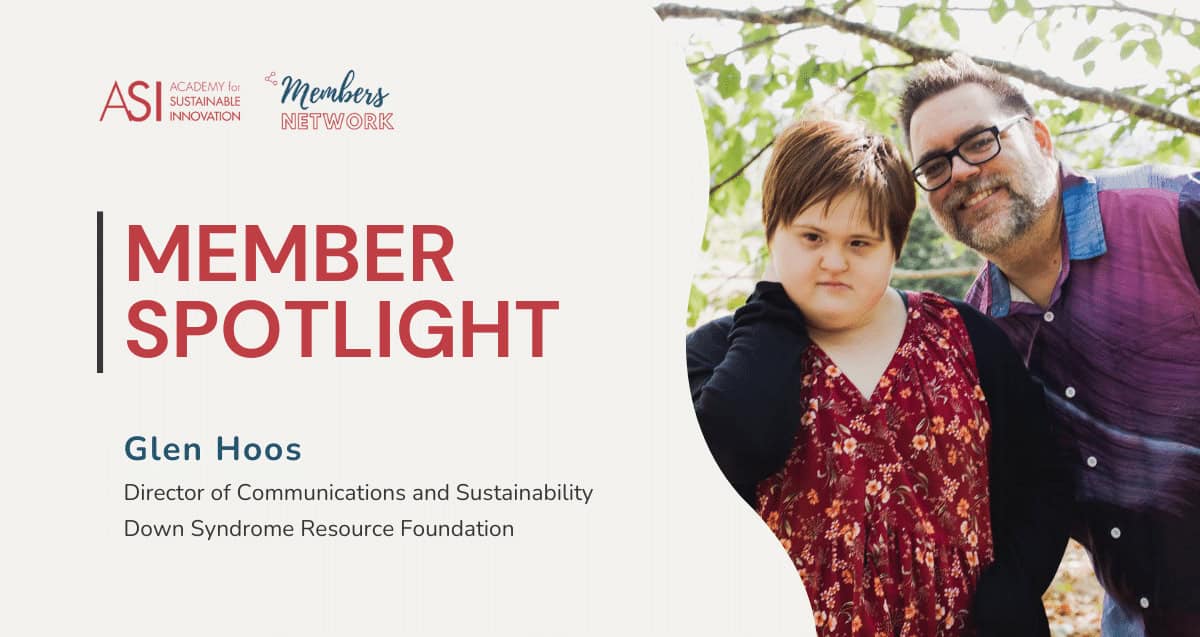
We are thrilled to welcome Glen Hoos (he/him) as one of the newest members of ASI’s Members Network. Glen is the Director of Communications and Sustainability at the Down Syndrome Resource Foundation (DSRF).
After graduating from the University of Calgary with a Bachelor of Commerce degree, majoring in marketing, Glen spent the first 11 years of his career in the nonprofit sector, gaining extensive experience in fundraising along the way.
Following three years as General Manager of a restaurant chain with locations worldwide, Glen joined DSRF in 2012 as Director of Development and Communications, where he played a key role in significantly increasing the organization’s fundraising revenue. In 2019, he became DSRF’s first full-time Director of Communications, and in 2024, sustainability was added to his portfolio of responsibilities.
Glen has a very personal connection to the work of DSRF: one of his four children is a DSRF student who has Down syndrome and autism, while another has multiple developmental disabilities including autism. Glen is also an active member of the BC Climate Emergency Campaign and is dedicated to ensuring that the voices of people with Down syndrome and other disabilities are centred amidst the climate crisis. Glen and his family live in Mission, BC.
We had the chance to ask Glen his thoughts on climate action, sustainability, and leadership. Read the short interview below!
Q: Where do you draw hope from in the context of sustainability and climate action?
Glen Hoos: This question made me chuckle because, to be honest, I would not characterize myself as a particularly hopeful person. However, the way that Greta Thunberg speaks of hope rings true to me:
"Hope is not passive. Hope is not blah, blah, blah. Hope is telling the truth. Hope is taking action. And hope always comes from the people... Once we start to act, hope is everywhere. So instead of looking for hope, look for action. Then, and only then, hope will come."
Greta Thunberg
In the past two years I’ve made a real effort to connect with other climate-concerned people and take meaningful action together. Though this hasn’t necessarily made me more hopeful about where the climate crisis is headed in the big picture, it has redirected my fears into purpose and showed me that I can make a positive difference in my little corner of the world – and that matters.
Andrew Boyd has written a great book called, “I Want a Better Catastrophe,” that gave me a useful perspective. We may not be able to avoid catastrophe, but our actions can contribute to making it a better or worse one. I want to make it as good as possible for the people in my sphere.
Q: What does leadership mean to you?
Glen Hoos: My chosen niche within the climate movement is at the intersection of climate and disability. I have two kids with developmental disabilities and professionally I work with people who have Down syndrome. The voices of people with disabilities – and particularly those who have intellectual disabilities – are seldom heard in climate change and resilience discussions. There is sometimes some hand-waving in the direction of “vulnerable groups,” but how often are they actually at the table? Not nearly often enough.
So, I try to lead by using whatever influence I have to platform these underrepresented voices. It is more than just a moral imperative (though it is that, too). People with disabilities have unique, hard-won wisdom to bring to bear on the climate crisis. They live their whole lives in a world that is largely hostile to their existence, navigating systems that were created without their needs in mind. This will be increasingly true for all of us as the climate crisis intensifies.
No one needs to hear from another middle-aged white guy like me. But they do need to hear from those who are on the front lines of climate impacts, as those with disabilities are. In my context, leadership means shining the brightest spotlight that I can find (or build) on them.
"The voices of people with disabilities - and particularly those who have intellectual disabilities - are seldom heard in climate change and resilience discussions. There is sometimes some hand-waving in the direction of ‘vulnerable groups,’ but how often are they actually at the table? Not nearly often enough."
Glen Hoos
Director of Communication & Sustainability at The Down Syndrome Resource Foundation
Q: How do you see the role of leadership evolving as we transition to a low-carbon, socially-inclusive economy?
Glen Hoos: A truly inclusive society can only be led by leaders who reflect that society. That means not just listening to but giving actual, meaningful leadership opportunities to those who have been historically underrepresented.
Our models of leadership must be flattened: leadership from alongside, rather than from above. Leading for we, not for me. A reversal of the truism that power corrupts. Can it actually be done? I don’t know. (Did I mention that I’m not a particularly hopeful person?) But somehow, that’s where we need to go, and I’m committed to taking action in that direction. Hopefully the hope will follow!
ASI’s Members Network is for sustainability professionals who want to accelerate climate action within their workplace, community, or personal circles.
We can’t lead climate action alone. Join this peer network to build our capacity to lead change, together.